Free tastings soon in New York

P.S. I found your old storybook under the bed. These are the ones you asked for every night.

Stories

Tales from the courtyard.

Four new tales, told the old way, one for each flavor. Read them slowly, the way they are told at night with the lamp turned low.

  1. The spiral comes backA tale for Jalebi
  2. The tree that kept the summersA tale for Mango
  3. One radio for the whole streetA tale for Shikanji
  4. The ice that came by bicycleA tale for Gulab
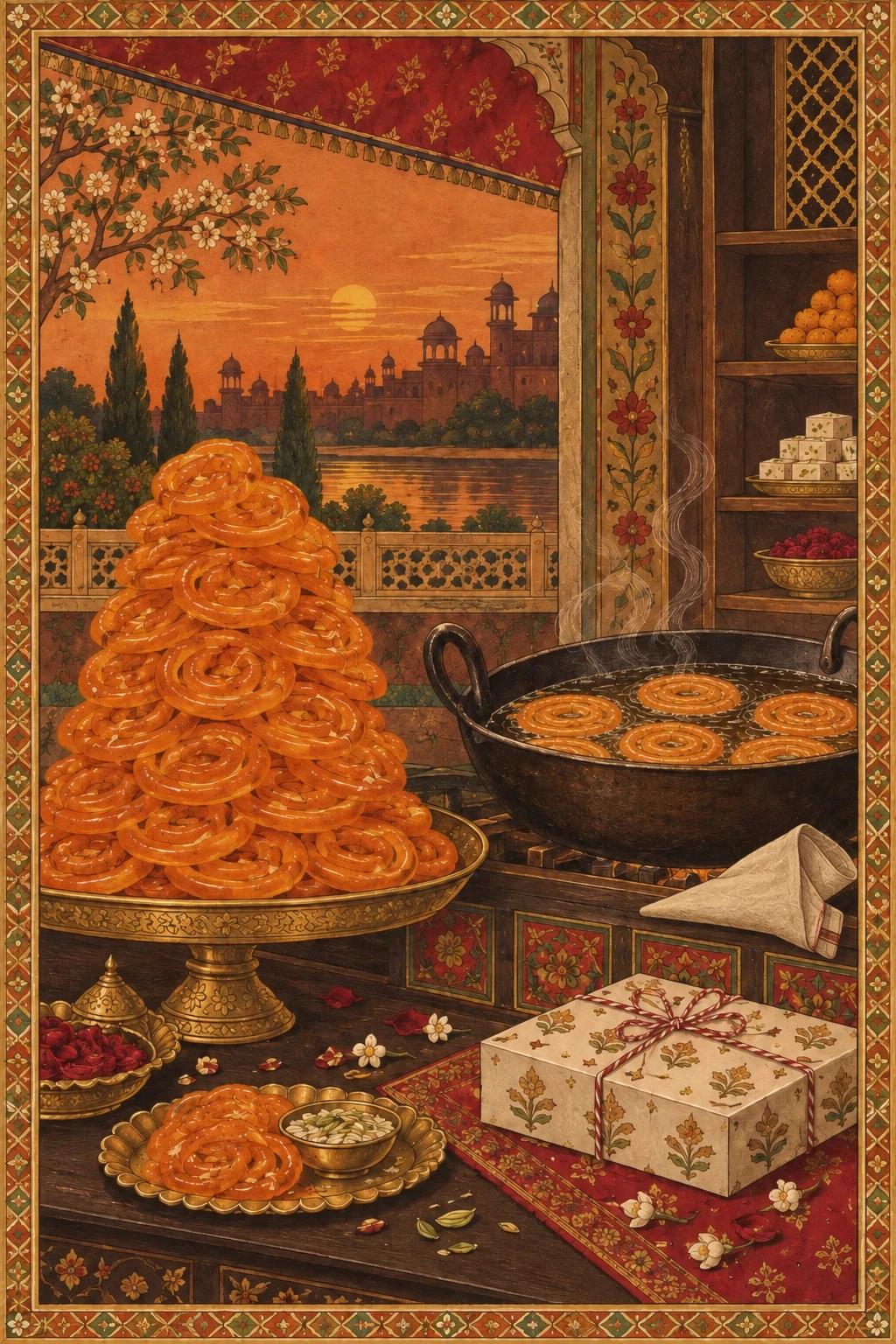
A painting in the Mughal miniature style of a sweet shop window at dusk, with a tower of jalebi on a brass stand, batter coiling into a kadai of hot oil, and a sweet box tied with string

A tale for Jalebi

The spiral comes back

There was once a sweet shop where the lane met the bazaar, and in its window sat an old jalebi wala named Rafiq, who had made jalebi there since before the clock tower stopped.

Every evening, at the hour when the lamps came on, a girl named Noor stood at the glass. She never had a coin. She came to watch his hand. He held a cloth of batter over the wide black kadai, and the batter fell in a thin bright thread, and his wrist turned, and turned, and in the hot oil a spiral opened like a flower. Gold, then orange, then dark at the edges like the sky behind the mosque. He lifted the spirals into a pot of syrup that smelled of saffron, and they drank it until they shone.

"Why always round and round?" she asked him once, through the open half of the door.

Rafiq did not look up. "A sweet that runs in a straight line is finished in one bite," he said. "A spiral comes back."

After that he kept the broken ones for her, the jalebi that had snapped in the syrup, in a twist of newspaper. She ate them on the walk home, slowly, so they would last to the gate.

When Noor was twelve he let her hold the cloth. Her spiral came out like a dropped string. He laughed until he had to sit down on the flour sacks, and then he showed her again. Not the hand, he said. The patience. Let the batter decide how fast.

Many years later, in a city where it snowed in April, Noor stood in a small kitchen with a bag of flour, a pan of oil, and a window gone dark at four o'clock. She had no cloth, so she cut the corner off a plastic bag. Her spirals came out crooked. One looked like a cat. She laughed out loud, alone, and the sound surprised her.

She thought of the lamps coming on in the lane, and the newspaper going soft with syrup in her hand. Everything she had left behind came back to her the way Rafiq said it would, round and round, a little larger each time.

That is the taste we tried to keep. Orange and saffron, a warm syrup, and the curl that brings you back.
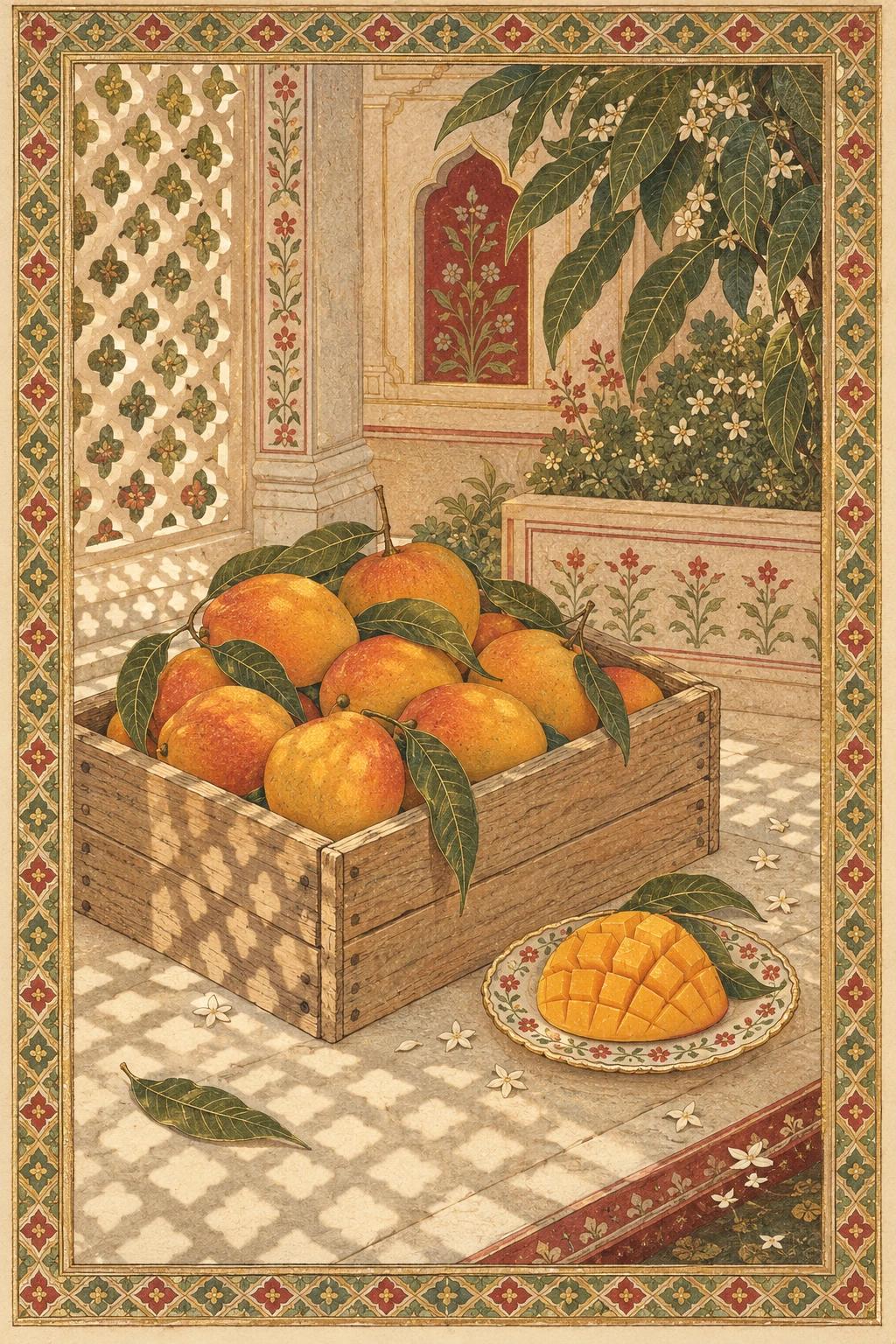
A painting in the Mughal miniature style of a summer courtyard with a crate of Alphonso mangoes and their leaves, a cut mango on a plate, and the shadow of a jaali screen

A tale for Mango

The tree that kept the summers

In our grandmother's courtyard there was a mango tree older than anyone could remember, and it was the tree, not the calendar, that told us when summer had begun.

First it flowered, small and sweet-smelling, and the bees came. Then came the hard green fruit we were forbidden to touch and touched anyway, and ate with salt and chili, and were scolded for. And then one morning in May a ripe mango fell onto the kitchen roof with a sound like a knock, and our grandmother looked up from her prayers and said, "There. Now the children can come."

And we came, from three cities, the cousins with their suitcases and their new heights. The mangoes cooled in a brass bucket of well water under the tree, a dozen golden faces bobbing. In the long afternoons, while the grown-ups slept under the slow fan, we sat on the cool floor of the veranda with a clay surahi sweating beside us. We ate mangoes until the juice ran to our elbows, and fanned ourselves with a palm fan that had her initials stitched on it in red.

She always kept one mango back, the best one, wrapped in a cloth in the dark of the grain room. It was for whoever arrived last. Every summer someone was late. Every summer the mango was waiting.

The tree is gone now, and the house with it, and our grandmother. The cousins live in nine time zones. But every year, in some late spring somewhere, one of us finds the first good mango in a market far away and sends a photograph to the others without a word. The replies come all day and all night, from every side of the world.

That is the taste of Mango. Alphonso, golden, cold from the bucket, and saved for whoever comes last.

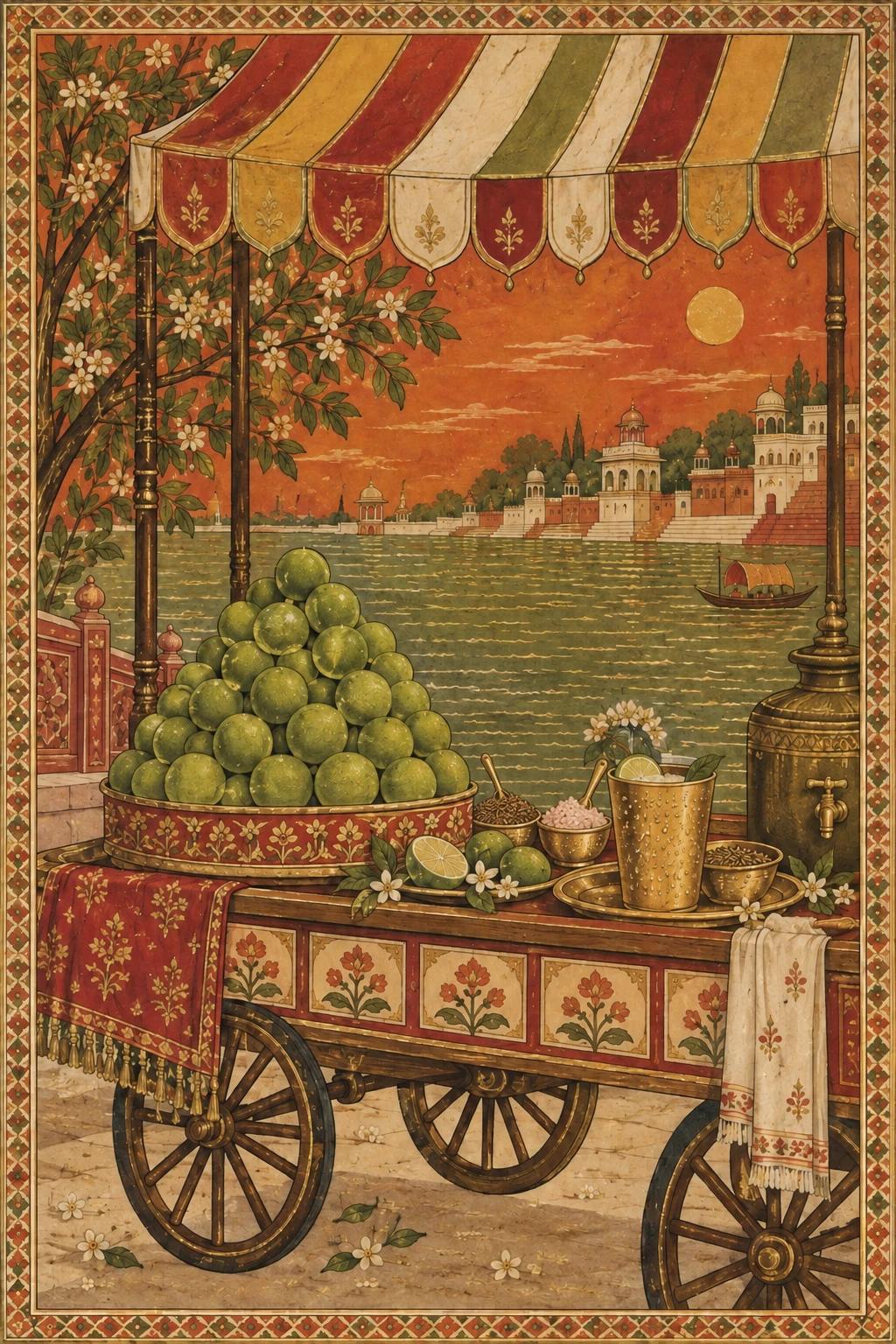
A painting in the Mughal miniature style of a street cart under a striped awning, with a pyramid of limes, a jar of black salt and cumin, and a brass tumbler of lemonade

A tale for Shikanji

One radio for the whole street

On the afternoon of the final, the electricity went out in the whole mohalla at a quarter past two.

It was the hottest week of the summer holidays. Every television went black at once. Up and down the lane the same groan came out of every window, and then the doors opened, and everyone came out into the white heat and looked at each other.

Except Bilal, who sold shikanji from a cart at the corner, under an awning striped like a boiled sweet. Bilal had a transistor radio. It was older than he was, made of wood, with a cracked dial and a hum like a bee in a jar. It ran on batteries. And it was on.

So the street went to the cart.

The boys came first, then their fathers, then the grandfather from the third house, who said he did not care for cricket and stood closest. Women watched from the balconies and pretended to hang the washing. A man nobody knew, who had only been passing through, put down his bags and stayed. Bilal turned the dial as high as it would go and started pressing limes.

He worked the way a drummer works. Lime into the press. Black salt, a pinch. Cumin roasted that morning, crushed in a stone mortar until the whole corner smelled of it. Water from the clay pot, a lump of ice, a stir with the long spoon. A glass for whichever hand was out. Nobody asked the price. Nobody paid that day, either.

It came down to the last over. Six balls. The street was so quiet you could hear the ice knock against the glasses. When the winning run came off the bat, the radio crackled so loud that the stranger dropped his glass, and Bilal hugged him, and then everyone was hugging everyone.

The power came back at dusk. Nobody went inside for a long time.

Years later, a grown man on a hot train far away checks a score on his phone, and his mouth remembers it all at once.

That is Shikanji. Sour, salt, cumin, and cold. A whole street holding its breath, then letting it go.

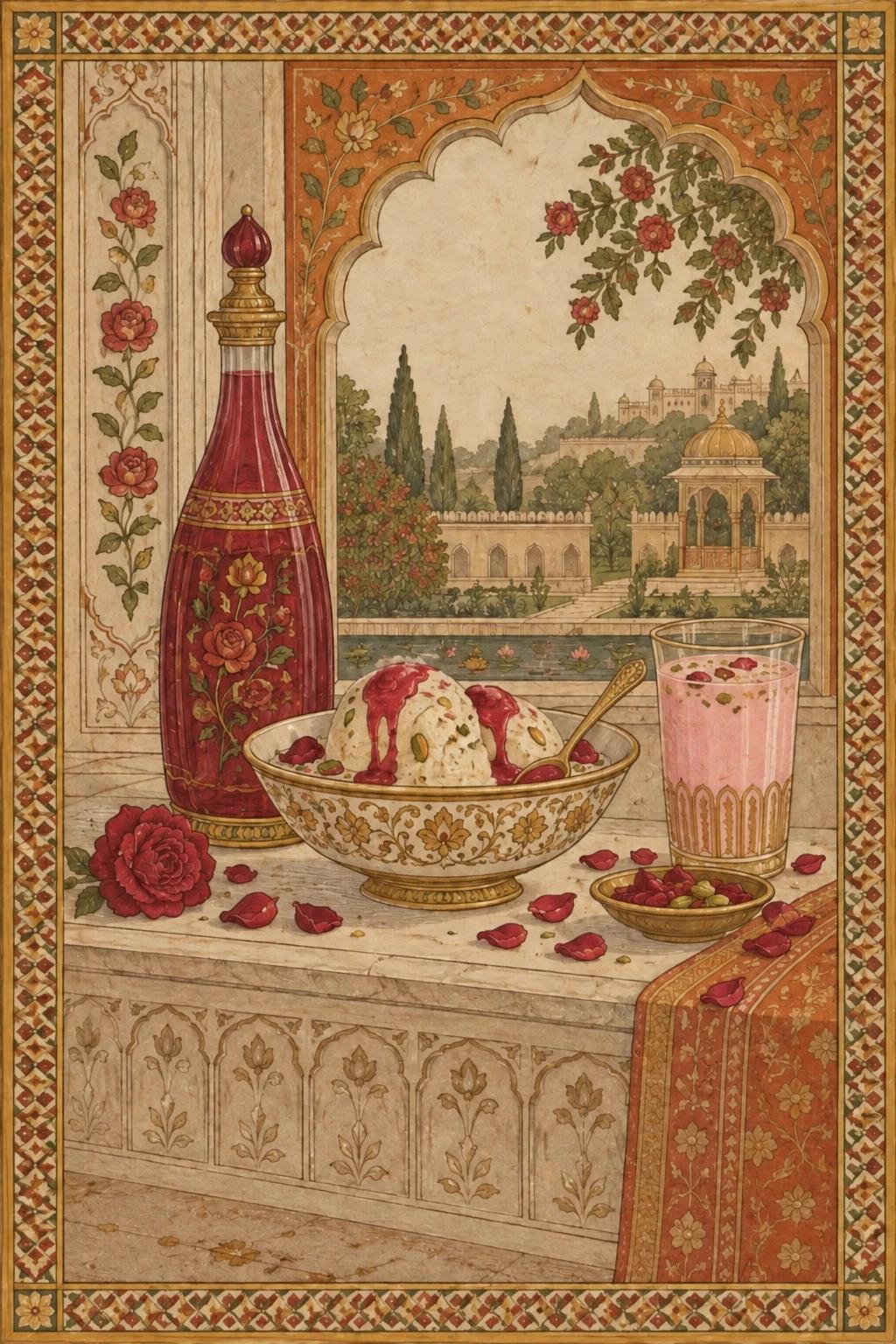
A painting in the Mughal miniature style of a carved windowsill with a bottle of rose syrup, kulfi under red syrup, scattered rose petals, and a glass of rose milk

A tale for Gulab

The ice that came by bicycle

In the May the tar melted on the main road, the ice came to our lane by bicycle. The barf wala was called Yusuf. He tied the block to his carrier in a jute sack, and by the time he reached our door half of it had become a dark trail on the bricks behind him.

My mother had a rule older than the house. Whoever comes to the door gets something cold. So she chipped a corner off the very ice he had brought, took the long-necked bottle of rose syrup from the high shelf, poured a red ribbon into the glass, and stirred until the water blushed. Yusuf stood on the step with the sack dripping on his feet and did not know what to say.

"It is your own ice," my mother told him. "You should taste it once."

After that he left our house for last. He would lean the bicycle on the neem tree, and I would run for the glass. I learned that he had four brothers and one pair of good shoes between them. I learned that ice sings when you crack it, a high note and then a low one. He taught me to carry a block on my shoulder without letting it burn. I taught him the names of the cricketers on the back of my exercise book.

Then the rains came, and nobody needed ice, and Yusuf went back to his village to plant rice.

On the last hot afternoon, he came anyway. There was no block on the carrier, only a small packet wrapped in newspaper. Inside were rose petals, dried, from the bush outside his mother's door. "For the syrup," he said, "so it is not only yours."

She kept them in a tin above the stove for years. I live far from that lane now, and when the bell rings on a hot day, I still feel the old rule rise in me.

That is the taste of Gulab. Rose, cold, and red, poured for whoever comes to the door.

The last page

Taste the ending.

Every tale ends at a flavor. Join the list, and we will write when a tasting comes to your neighborhood.

Which would you taste first? (optional)

No spam. One click to leave. Privacy