P.S. You asked why we never wrote the recipes down. We were keeping them for you.
Our story
A craving you carry from home.
Some tastes find you years later, on a cold street, an ocean away from the lane where you first had them. We make sodas from those tastes.
chaska (n.)
A craving you can't shake.
The name
One word, from Lahore to Dhaka.
Chaska is Hindi and Urdu for a craving you can't shake: the taste you keep going back to. People say it in India, Pakistan, and Bangladesh, and in every city where we have made a home since. Nobody needs it explained. You say it with a small smile, about a sweet you should not have had twice, and did.
The C in our wordmark curls into a jalebi, the sweet nearly everyone in South Asia knows on sight. The spiral is the craving itself. You go round, and you come back.
The flavors
Four tastes we kept looking for.
From the sweet shop
Jalebi
The orange spiral in the sweet shop window, and the stack of it on the wedding table. The jalebi wala dropped the batter into hot oil in rings, then let them drink their syrup until they shone. You ate the broken ones on the walk home.
Meet JalebiFrom the mango tree
Mango
The mango everyone waited all year for. A crate of Alphonsos on the veranda, a dozen golden faces cooling in a brass bucket of water until lunch was over, and the juice running to your elbows.
Meet MangoFrom the street cart
Shikanji
The lemonade from the cart under the striped awning. Lime pressed while you watched, a pinch of black salt, cumin roasted that morning and crushed in a stone mortar. Nimbu pani to some, shikanji to others, the same cold relief to everyone.
Meet ShikanjiFrom the open door
Gulab
The bottle of red rose syrup that came down from the high shelf whenever someone knocked. A ribbon of it in cold water for a guest, in milk for a child, over kulfi on a summer night. Every family had one. Every region had its own name for it.
Meet Gulab
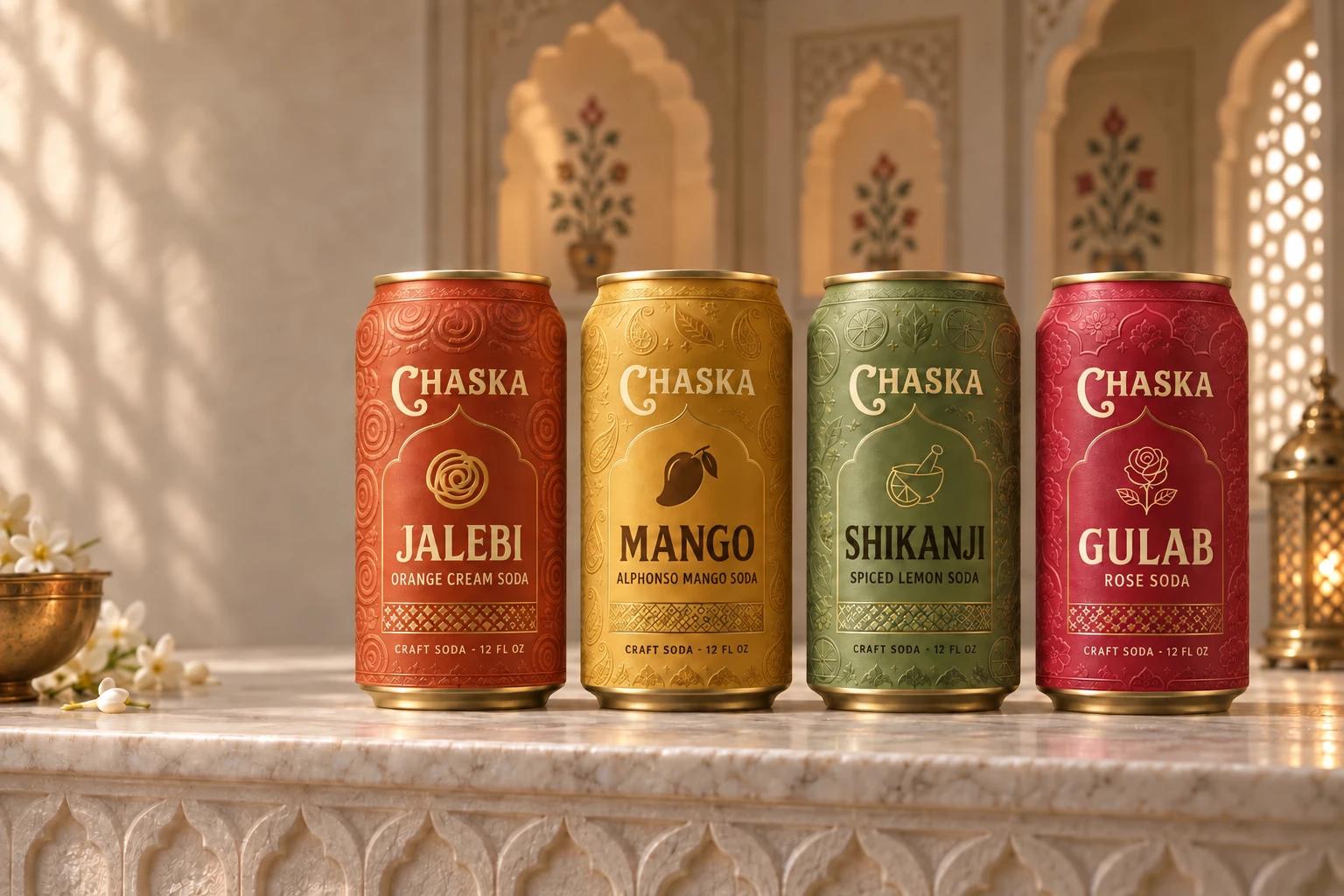
Jalebi, Mango, Shikanji, and Gulab are our first four flavors, and they arrive together. Each recipe is made with cane sugar and is still being tuned with our manufacturer. Full ingredients come with the first cans.
The room
A palace dining room, faded by the sun.
The look comes from the carved rooms of the Mughal cities, as people still meet them today in dining rooms that keep the old light: white plaster cut like lace, jaali screens, onion-dome arches, painted niches with a vase of flowers in each, and lamps burning low.
We added the wear of time. Limewash faded by a hundred summers. Colors named for what is in the kitchen: sindoor, amchur, khus, and the red of rose syrup. Every photograph on this site sits in an arch, like a window in that room.
The gold
Satin antique gold, like old gilding on carved plaster, never a mirror. We put it where a palace puts it: on the carving, not on everything. The arch, the rules, the jaali band, and the lid.
The texture
In our designs, each can carries its own pattern pressed into the body, tone on tone: jalebi coils, keri with mango leaves, lemon slices in a star lattice, and rose blossoms. Whether the first cans carry it as a raised finish depends on the printer. We will tell the list when we know.
The ornaments
Every border here has a home.
Nothing on this site is pattern for its own sake. Each ornament is drawn from a craft of the region, and each is named for where it comes from.
Buti block print
Sanganer and Bagru, Rajasthan
Small flowers stamped by hand from carved teak blocks, one press at a time, along the edge of a sari or a quilt.
Kantha stitch
Bengal
The running stitch that turns worn saris into a new quilt, row after row of small stitches.
Phulkari
Punjab
Silk floss in satin stitch on handwoven cloth, worked from the back in diamonds, for a bride's shawl.
Alpana and kolam
Bengal and Tamil Nadu
Drawn on the threshold at dawn in rice paste or rice flour: a lotus, a ring of dots, a line that loops back.
Jaali
Mughal screens, from Agra to Lahore
Stone carved into lattice, so a room could have light and breeze and still keep its quiet.
Keri
Kashmir, and every mango orchard
The paisley of the Kashmir shawl. In much of South Asia it has the name of a small raw mango.
Truck art
The highways of Pakistan
Scallops, studs, and hanging chains painted on trucks, so even the longest haul goes in color.
Who it is for
If you know, you know. If you don't, come in.
First, for everyone who grew up with these tastes and now lives far from where they first had them. Then for everyone who loves the food and has never had it cold, from a can. Nobody needs a glossary at our table.